
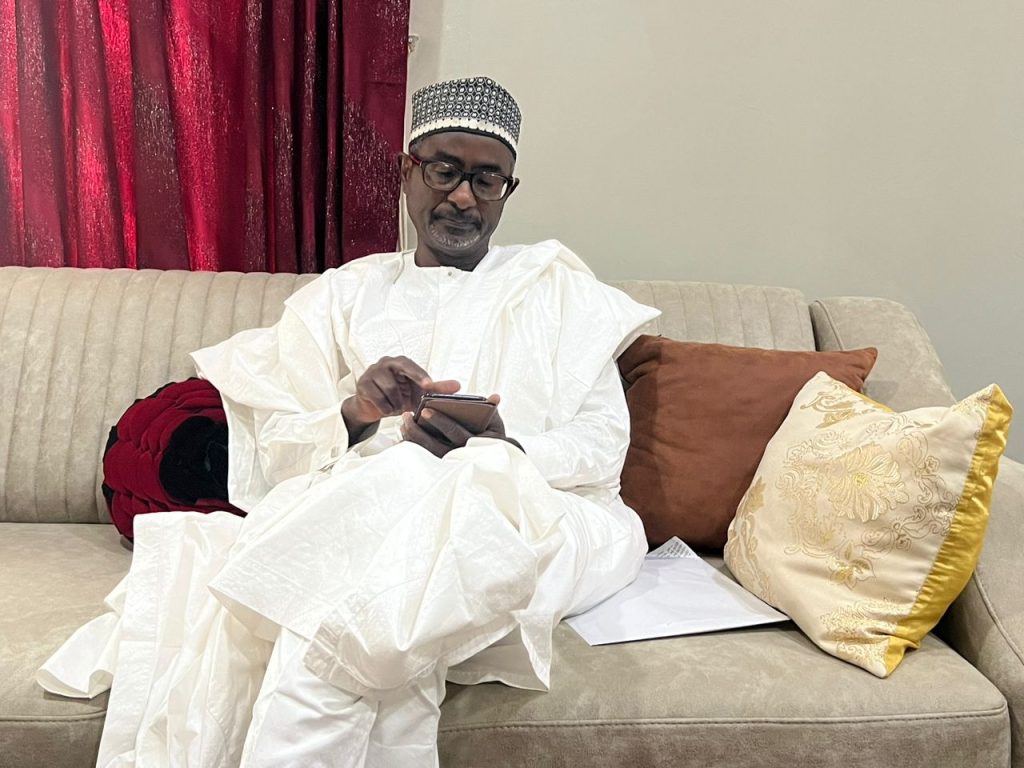
Mallam Kabiru A. Yusuf is the founder and Chairman of Media Trust Limited, publishers of the Daily Trust newspapers. Kabiru was Managing Director and Editor-in-Chief of the Daily Trust for many years. He also holds the position of Chairman of the Newspapers Proprietors Association of Nigeria, NPAN, and member Board of Trustees of the International Press Institute , IPI. Kabiru was editor of the Daily Triumph, Today and Citizen magazine. He was Southern African correspondent of the British Broadcasting Corporation, BBC. A Fellow of the Nigeria Leadership Initiative and former university lecturer, Kabiru holds a Bachelors of Science in Political Science from Ahmadu Bello University, Zaria (1979) and Masters of Science in Political Economy from University of Toronto, Canada (1982). He is also a member of the Aspen Global Leadership Network (AGLN). In this interview with the EXECUTIVES’ Editor-in-chief, Ibrahim Dan-Halilu, KABIRU A YUSUF shares his experience as a media entrepreneur, the major challenges and prospects of the Nigerian media industry, and lead us into his personal life after retirement from active journalism. He offers some insights for upcoming media entrepreneurs, who want to join the fray.
First, what I would like to ask you, sir, as a pioneer editor and co-founder of several media organizations in this country, What can you say are the prospects and challenges of managing or running a media organisation in Nigeria?
I think it used to be a bit easier when I started, let’s say in the mid-80s, 40 years ago. The challenge is probably less than it is today. There was no social media.
So, the traditional source of news is either newspaper, or radio, or television. At that time, nearly all of the broadcast media are owned by government. So, it’s only one source of news. It’s official news. Even the newspapers, more than half of them were owned by government. So, if you were able to start a private newspaper, there was something different about it.
You can do news that is not government-related and I think then the audience appreciated independent newspapers. There were just a few independent newspapers and magazines in the country. So, there was a big audience. As reflected in the circulation figures, there were newspapers in this country that were doing 200,000 copies a day, 100,000 copies a day. Now, if you put together all the newspapers in the country, they are not doing even 200,000 copies. So, you could see that there has been a huge change, a sea change, whereby the traditional media is actually getting more squeezed out of the public consciousness and the social media is now taking over.
Nearly everybody accesses it on his phone, on his tablet. So, newspapers are in a bad way, even though a bit is compensated by the broadcast media. There is more private broadcast media now than 40 years ago and that’s also getting quite a bit of audience.
So, are you saying that the media in Nigeria has no prospect? There’s no prospect for the print media in particular?
I think what I’m saying is to survive, it has to adapt to the new reality of the internet, whereby people are able to access their news online, quickly as it happened, or as it happens, and they will not wait for a newspaper till tomorrow. By the time you come out the following day, unless you adapt to this reality, and I think one way to adapt is for the newspaper to add value to what people already know.
If 10
people have been kidnapped in a community and everybody will know about it in the evening, online, maybe even through the broadcast media. By the following morning, unless a newspaper can now tell us who are these 10 people, what are their names, what do they do for a living, possibly what is their picture, so we can relate with them as human beings. So, I think a newspaper adaptation I’m talking about is that a newspaper has to have an online presence so that it also competes in that space.
So, as you know, every newspaper now has a website. As soon as something happens, they have an online output, and then the print has to add context and depth, not just headlines that say 10 people have been kidnapped, which everybody would know, but who are those 10? Where were they? Is there any update? So, this is a challenge we all face as a newspaper. We are trying to adapt to this new reality, and it’s not easy, like most things happen when they are new, but I think we are trying to adapt. So, it is not an impossible situation. It can be done.
What in your view has been responsible for the collapse of many media enterprises in Nigeria? Because we have so many collapses, they just come out after a few months or a few years they just disappear.

I think sometimes people start newspapers without realizing the challenge of sustaining them. Sometimes they really don’t take the trouble to provide the news that will win them an audience, and subsequently the advertising that follows it. So, a lot of the newspapers you are saying which will collapse, many of them have been set up on a very faulty foundation. Business-wise, a lot of publishers go into it without a serious business study. What is the audience you wish to address or to satisfy? Are you going for women? Are you going for youth? Are you going for the elderly demographics? You have to determine that. If you choose your audience, you have to now try and satisfy the audience.Tailor your news to satisfy them.
And you also have to stay on the job, because if you come in as a new newspaper, you will probably find others already there. So, why should the reader switch to you, unless you provide something compelling, and the news will begin to go out, oh, have you seen that new newspaper? And it can be very slow. It can take years for people to even notice you are there. So, those who are in a hurry, you come in, you are expecting something to happen, it doesn’t, they quit. And there’s another category that I call the ego publishers.People publish in order to kind of satisfy their own ego, to be called publishers, or whatever, editors. And they’re not really doing it for the audience; they’re doing it for themselves. They want to be introduced, it’s like politicians.You find somebody just sitting somewhere, and he stands up today and says, I’m running for governor, or I’m running for whatever, president. And people humor him, even
though he doesn’t get even more than 10 votes. From that point on, they’ll start calling him his Excellency, or Mr. President, or whatever.
So, people do those funny things. But I think that clearly, they are not intending to stay there. Many of them are not professionals; they don’t understand what it takes to do it. So, they’re just doing it for their own ego.
Let’s go specific, sir. As the former editor of the Citizen Magazine, you know, Citizen Magazine was one of the first magazines in northern Nigeria. And after coming out, it came out at a time when there is no strong media presence in Nigeria, in northern Nigeria, specifically. Why did it fold up?
I think a number of reasons. Citizen was able to win a very big readership. It started about 1990, and lasted four or five years. In that period, because of the quality of editorial output, it captured a good readership. It even captured quite a bit of advertising. However, I think it was not well capitalized, because such projects will take a long time to break even, to make enough money to sustain themselves. You find that typically in other environments, somebody who invests in a newspaper or magazine is not expecting it to be profitable within two or three years. It will take much longer, five years, ten years in some cases. So he has to be able to find the money to keep it going.
Because like I was saying earlier, when you come into the market, there are already other products there. So you have to prove yourself. You have to win the audience. And a lot of the times, it’s a very gradual process. People are creatures of habit. If I’m used to reading my newspaper, maybe I’m used to reading a certain newspaper. You will find that people associate newspapers with a certain brand, because they’ve been there.
If you are in Lagos in the 40s, 50s, you think every newspaper is called the Daily Times. For some time here in the North, in the 60s, 70s, it’s the New Nigeria. So people are used to that. So when you come into the market, people take time to study you. They may not switch loyalty. They have to put their money. You have to prove it.
And I think Citizen didn’t have time. It has good quality editorial output. I was part of the team. We used to say that we have a good editorial output, but our business side is weak. And the weakness of the business side
started
with the capital.
We didn’t have the resources to have a good structure, to have good staffing, and to have all the equipment necessary to produce the newspaper well. And we were hoping that we would get that from the market. It turned out that things were more difficult than we thought.
The second thing is that the magazine format, not just Citizen, but all other magazines, gradually, for some reason, people move away from magazines. Where are all the magazines that made name in Nigeria? New Breed, New World, TELL, Source, wherever. Where are they? They have disappeared.
The newspapers are still around, but later. So I think something happened. The magazine format was not working.
I think we didn’t get it right. Maybe we were not doing the kind of in-depth reporting, the kind of context, the kind of things that newspapers are not doing. But if people are now able to see in their daily newspapers what comes out in the weekly magazine, why would they take the trouble? Unless you are giving them something special, something unique.
So yeah, for some time, the columns were doing… because the columnists were able to get an audience, and I think we had good columnists. Some of the cover stories were doing once in a while, but I don’t think it was enough to really sustain the audience beyond this period when the magazine disappeared.
The Media Trust, which you and other colleagues midwived, has now grown into a vibrant and profitable multimedia outfit. I just finished watching the media, the Trust Television, and I’m sure probably you are thinking of establishing a radio, or you already have one. So it has grown into a multimedia outfit. Can you share the secret of this tremendous success with our audience?
I’m not sure there’s a secret. I think there was a lot of luck.Maybe our timing was good, and nobody can determine timing. When we started in 1998, we didn’t have the capital, so it could have ended up like the Citizen. The capital was very small, we had no press.Learning from Citizen, we avoided the magazine format. We could see there was some problem with the magazine format. So we said, okay, let’s start with a weekly newspaper with the aim of growing into a daily.
At the time, of course, in the north, there were not many newspapers, as usual. This is the story of the north. There was New Nigeria, which also had started having problems. Some of the other private efforts had closed down. Democrat, Reporter. So we thought, yes, try and work.
The ones owned by government are also struggling. So yes, there’s an opportunity. But of course, there was no money. So we had to start as a weekly. The reason why I say the timing was good, or luck was on our side, was that we started under Abacha. At that time, the country was almost moving into a kind of dictatorship. Abacha wanted to continue as president. And if he had continued, probably we would have gone under. They would have found a way to shut us down. But Abacha sadly died. And the new government under Gen. Abdussalam made it clear that he was spending a very short time, less than a year, to hand over. So there was a surge of political activities.
And we now decided that, look, instead of being a weekly based in Kaduna, we should take the plunge and do a daily based in Abuja. It was then the new federal capital. So we seized that opportunity. Political activities were starting. Democracy was coming. Parties were going. People were reading newspapers more. And here we were with the northern viewpoint in many ways. So I think that was the timing.
And then being in Abuja, because we now realized that, well, maybe Kaduna has become the graveyard of newspapers. Whichever one started, would collapse there. So we said, why don’t you try Abuja? And Abuja now became in a way like Lagos, gradually. It’s the center of government. There was a lot of advertising from the ministries. And you know, sometimes the way they did things. Some things are done at the last minute. And here we were, situated in Abuja. So they said, look, we have to have it in the paper tomorrow. Which paper? Very much closer. So that’s the element. We realized that maybe we should muzzle into Abuja, even though we were really not well prepared for that. But if you wait to be prepared for something, you’ll probably never do it. So that’s the story. We seized an opportunity. And I think God has blessed the project. And here we are 25 years later.
How do you assess the relationship between the state and media in Nigeria?
Well, it’s always a very tense relationship.If by the state, you mean governments. Governments don’t like, even if they say they like, what do you call, constructive criticism. They are just saying it, from my own experience.
They don’t like criticism. The government thinks it is doing its best. The citizens are not appreciating. They believe they don’t know the difficulties. Or the critics in the newspapers are sponsored by their enemies, who don’t like them. So they have a very negative, they really don’t do what is advised in religious knowledge. Where it is said, look, if somebody criticizes you, it may be painful. But look at it and see what is of value, that you can improve yourself. Invariably, there is something. Invariably, we’re all human. And governments are very much more than human, actually. So invariably, there is something. Maybe the criticism, a lot of it, some of it is misdirected. Some of it is reasonable, or whatever. But if you take it positively and say, okay, these guys are saying so, so, so, let’s sit down.
What is right? What is wrong in this? Let’s pick what is right and improve. Governments are not wired for that. They feel, oh, why are these guys doing it? Who is begging them to do it? So there’s always this bad relationship.
But I think we are telling them, if they don’t like it, they have to live with it because nobody asks you to be in government. Nobody asks you to go and be a governor or a president and be in charge of our commonwealth.
So if you take on that job, you should be prepared to be questioned, to be criticized. And that’s what good newspapers do.
So how would you rate the performance of media in Nigeria?
I think we are doing our best in the face of very serious constraints. I’m the first to admit we have our own faults. Journalists are humans. Some of them go into it for the wrong reasons. Some of them find themselves in the pressure of making a living, which every Nigerian is facing, some of them fall by the wayside, go into wrong things, wrong habits. Maybe doing stories that they know are not true, but are appealing, people doing wrong things. So we have our problems and we are trying to correct them.
I don’t know if you noticed that one of the things the Newspaper Proprietors Association of Nigeria has done recently is to set up a Newspapers Complaints Commission. It’s already in operation. Readers who are unhappy about a certain report, instead of going to court, because we know how our court processes are, it’s very expensive, it can take a long time, they can come to the Newspapers Complaints Commission. I would call it the ombudsman, lay their complaint. I am aware, for example, just a week ago, two weeks ago, one of the
newspapers in Lagos, somebody wrote a complaint about what they have done and this complaint was reviewed by the Newspaper Complaints Commission, and they found that the complainer was right, the newspaper was wrong.
And according to the rule of this Complaints Commission, the newspaper has to, within seven days, apologize, publish that response, and apologize to the person. If they don’t do it, then the other newspaper they come to will take it up and do that. And the seven days probably ended today.
Because I’m aware of this, as a member of the Executive of the Association, so we have started something to try and correct ourselves. But I think on the whole, given the constraint in the society, in the economy, newspapers are doing their main job, which is to hold governments to account. Without newspapers, without the media, look at the scandals that are breaking out all over the place. Who will know? Even now, a lot of things are happening. Newspapers could do more, actually, but they don’t have the capability. And the people who are doing these things don’t care. Perhaps it’s happening all over the place, so how many can you uncover?
But still, the presence of newspapers and other media outlets has helped to moderate the behavior of political actors who grab power and think they can do whatever they want.
Poor remuneration for journalists is regarded as one of the downsides of media practice in Nigeria. How do you think the situation could be reversed or improved?
It can only be improved when newspapers themselves do very well. You can’t pay what you don’t have.
Why did they start the business in the first place?
No, no, they started the business with the hope that they will do enough to pay their workers well. And those who are doing well are paying their workers well. That’s a good point to admit. Nobody who knows how to run a business will earn money from the business and refuse to pay the workers who produce the result. He’s not a businessman. And those who do that are some of the newspapers that, as you say, will collapse.
So every good business, whether newspaper or not newspaper, your ambition, your aspiration is you start small, you grow, you make money if possible, you use that money to improve the business. And one of the most important areas of improvement is to pay your workers, to pay them and to keep improving the payment. Otherwise they will go elsewhere, not just in the newspaper, they can go to other industries. So I don’t think there is any sensible newspaper or business, that’s why I’m generalizing that no business will do well and refuses to pay its workers.
The reason why you see that many newspapers where there are complaints about people not being paid and all that is because the newspapers simply don’t have the money.
So what do you suggest in that regard? Should it continue that way? Journalist practicing, going to his beat but at the end of the month he or she will not get any pay, and then he’ll be looking for brown envelope and that definitely compromises his performance, I mean his ability to really do his job as the profession actually expected of him or her?
If as a journalist I find myself in such a newspaper, I will leave. Why would I stay in a newspaper that promised to pay me something and I need that pay, and they are not paying me. So why are the journalists staying?
Because there’s no job opportunities. Just struggling.
In that case, it has become a situation where you can not only blame the newspaper or the publisher. If somebody made the decision that well they may not pay me but after six months maybe they’ll pay me three months’ salary, it’s better than nothing. So it is a situation we have found ourselves. The economy is doing very poorly. If you quit, another alternative is okay, all the newspapers that cannot pay, let them shut down. Will that improve the well-being of the journalist? So I think people are making the sensible decision.
But wouldn’t you suggest that maybe an organisation like the Newspapers Proprietors Association of Nigeria or any other similar body come up with a trust fund that would support some of these media organisations that are under?
Who would provide the money for the trust fund?
Probably, from the proceeds of adverts revenue of other successful media organisations like yours.
So you mean the successful newspaper fund the less successful?
It’s not a dash but like a trust fund.
What is a Trust Fund?
It’s like leverage or support system for ailing media organisations that are in dire need to sustain their business, they can take a loan and repay later.
But loans are only given by banks.
They are not loans anyway, you may call it grant.
Incidentally, there is an effort to launch a trust fund. I don’t know how successful it will be. But the idea is to ask businesses that are doing well, non-governmental organisations that are rich, and even private individuals, and say look newspapers are important in any country’s democracy, they are in deep hole. Can you provide funding that a responsible Board of Trustees will now administer this money so that journalists are paid? You may not give the money to the publisher for fear that he may spend it on himself. But if your concern is let’s say journalists not being paid so that they do their work well, you can do that. There is an effort to do that but believe me it’s not as easy as it sounds because who will give the money? Do you have businesses and individuals now who when you make …I know it’s easy to write to them that newspapers need this and that. But will you get the checks? I have experienced it in this place.
There will be an assessor, somebody coming to assess the needs of the media organisation.
The concern is there that we are in a situation where you can’t go to the bank and get money, readership is really dwindling and advertising can’t support the newspapers. So what do we do? Yes, there are schemes like that asking people to support good journalism. Some environment even ours there are such mechanisms, where you say look, you enjoy reading newspapers, you enjoy the work newspapers do, please support. I hope that works. But I probably wouldn’t sit here and wait for the day trust fund will come and give us money to run the business.
Yes, because you’re successful. But the unsuccessful ones will need it. Some of the serious ones that are into it just find themselves may be because they don’t have capacity to propel the organisation to success because it’s a matter of strategy and vision.
Without any sentiment, there is no law that says a business will succeed. Any business that doesn’t get its strategy will not survive. Even there are businesses that will spend hundred years successfully, but they still strategize. None of us is free from that risk, including the so-called successful ones. You’ve to continue strategizing. If you get your strategy wrong, the price is what happens to you, and nobody is free from that.
So I don’t mind seeing a trust fund that will help newspapers in trouble, and I’m part of the effort to it. But like I said I wouldn’t go bed thinking that I’ll get funding from a trust fund.
Do you support the idea of professionalizing journalism like the medical practice, law, accounting or engineering where they say one must be certified and get registered by a national body before one can practice?
No, I don’t support that because the trend in journalism is that everybody is becoming a journalist. Not only those of us who said we are professionals. Even among the professionals there are those who did not even study it in university. There are many who studied all sorts of subjects. Journalism is a generalist thing. So for you to now say somebody must have a certificate… training helps, no doubt about that. You need to be trained, you need to know how to write, how to construct stories, how to avoid libel. All those things are important. I think every good newspaper organisation will do its work to train you. Even how to manage the company, how to keep the accounts. Yes, there are professional aspects but I think in terms of news gathering, it’s becoming wide open.
Indeed, there is a course on Citizen Journalism now. Somebody sitting in his house and something happens. Where are the journalists? So it’s the man with a phone next door who captures the graphics or images of what happens and shares it with a media organisation. If you say that man should not provide you with that information because he doesn’t have a diploma in journalism, who is losing?
I know that government is trying in some ways to say that we have to regulate, to register, I think they are doing it more for the reason of control than to improve the quality of journalism.
What do you regard as the major challenges of journalism practice in Nigeria? Are they peculiar to Nigeria or universal?
Some are universal. All of us are suffering from the incursion of the social media. Technology has disrupted how we practice it but we are trying to catch up. How do we make our websites attractive to audience? So that is general. In our own case, peculiar things may be the economy which is going down. In other African countries the exchange rate is predictable and manageable. But look at our own case. Some of the challenges of running the business have to do with the economy, the low purchasing power of the people which affects our sales and low advertising revenue.
I was caught in a discussion. I was talking to an editor of a newspaper in Namibia, and he was complaining that their readership has dropped by half in the last two years from 50,000 to 25,000. This is in a country of two million people. I said I wish we have your problem. You can see they have their own peculiar problem but ours is worse. We used to have 100,000 and the copies we produced were not even enough to go round. Today, the situation is that people cannot afford it. My prayer is I hope it’s not a terminal problem that will really affect the newspapers.
In terms reporting on corruption and insecurity, would you say that the Nigerian media has done well enough?
I think the Nigerian media is trying.
Why I asked this question is because it has been observed that most times the Nigerian media reports on these issues without making follow up. There are so many cases of corruption that the EFCC has not pursued to conclusion and the media is not talking about it.
That’s a fault we must accept. But it’s a typical thing in the media. Everybody goes after the new story, leaving old ones. Now, Beta Edu, what’s happening? You know that government has a way of downplaying issues by saying we have set up an investigation, but they will never make the findings public. If you try to ask questions, they will say why don’t you wait for the report of the investigation? But it’s another way to pacify the public and convince them that the government is doing something. But it can take six months or more you won’t hear anything.
Why am I asking this questi? Look at the case of Halima Shehu who was accused of moving 32billion Naira into private accounts. I don’t think any journalist has gone out of his way to interview her, and get an update or her own side of the story.
May be they have tried. Imaging if you were her, I know in such situation, some people in her family may say don’t talk, you can’t fight government. If she talks…Because already some people are implying that it’s because of what they did to her that is why she roped in the minister.
What advice will you give to aspiring media proprietors who are just starting?
There is no simple answer, no simple formula. I encourage everybody to try. Entrepreneurship has no secret. I don’t want you to say oh if I do this, I will fail, if you do this, you do nothing. I will say, let’s all try. Try and do something, try and ask yourself questions. Ask yourself, why am I doing this? Be sure to yourself and your conscience, you and your team. We do that constantly. You know we are humans. Are we doing the right thing” Is this the right way? Do we do it differently? If you go into it with the kind of mind look I’m into it, I want to keep improving, it is not a one day wonder which you’ll just start tomorrow… all the things that apply to business. Your prudence, you measure what you’re doing, if something is wrong you correct it, I think that’s the way.
So how is life after retirement because I observed that you’ve retired from active journalism? You’re more of a CEO now and that’s the reason why we are reaching out to interview you as a CEO, because you’re a media mogul.
How can I retiree be a mogul (laughs)? Yeah, I think I’m retiree without the…. I have no executive function. But I still have a role in the newspaper. I advise and all that. I enjoy flair of journalism. That what all of us do. If I’m an old journalist, if I see something I send it to the editor and say have you seen this. It has become part of my life. I don’t think I’ll ever reach a point where I don’t care.
Otherwise for the rest, I would like to do occasional things. If I go to a very interesting place, I like to write about it. I do it less because now I’m worried about drawing attention to myself. I didn’t use to care when people say this guy is travelling all over the place. Sometimes when I do it, it occurs to me to write but I say No.
Travelling is good. People used to enjoy your Travelogue.
Yeah, that’s true. But when people are beginning to say ah this guy is travelling all over the place. They say that to me, and I began to be sensitive about it. …I used to like it myself because it’s a way to recall what you’ve been through.
What I’m saying is that I like to do a beat of journalism like occasional interviews, occasional writing…So that’s the kind of retirement. Then enjoy the rest of the time. I have always been involved in public affairs. This is part of journalism.
No farming, no agriculture as a typical Fulani man?
It’s not typical. We are all children of farmers. Most people inherit a farm or buy one. So when you reach certain age you want to have a farm and pass it on to your children. A lot of the time is more like a hobby. Alhamdu Lillah, I enjoy the retirement. I still like to read, to learn, I went back to the university in my sixties to do a Master’s degree. I just don’t want to sit there in an image of a retiree, watching TV.
Trust Dialogue. Is it still alive? Is it coming up?
It’s coming up next week. We’ve been having it for 21 years when the newspaper was fairly young. It is part of the public affairs I was talking about. We do it to throw light on what is going on around us. We debate, we talked about.

+ There are no comments
Add yours